Cost of Living in 2026: The Cheapest and Most Expensive Countries to Live In
From rent to groceries to Netflix — we rank the world's cheapest and priciest countries using real price data across 400+ products.
"How expensive is it to live there?" It's the first question anyone asks before moving abroad, planning a long trip, or considering a remote work relocation. We set out to answer it with data — tracking over 400 products across 40 countries to build a complete picture of global cost of living in 2026.
Rent: The Biggest Line Item
Housing is typically 30–50% of anyone's budget, so let's start there. A one-bedroom apartment in a city center ranges from under $300/month to over $2,200/month:
| Country | 1-Bed City Center Rent |
|---|---|
| 🇸🇬 Singapore | $2,200/mo |
| 🇨🇭 Switzerland | $2,200/mo |
| 🇺🇸 United States | $1,800/mo |
| 🇮🇪 Ireland | $1,800/mo |
| 🇬🇧 United Kingdom | $1,700/mo |
| 🇦🇺 Australia | $1,600/mo |
| 🇦🇪 UAE | $1,500/mo |
| 🇨🇦 Canada | $1,400/mo |
| 🇳🇱 Netherlands | $1,400/mo |
| 🇳🇿 New Zealand | $1,300/mo |
Singapore and Switzerland tie for the world's most expensive urban rent at $2,200/month. Singapore's tiny land area and booming economy create fierce competition for housing. Switzerland combines high wages with strict building regulations and an influx of international workers.
On the other end, countries like Pakistan, Egypt, and India offer city-center apartments for $150–350/month — less than what many Western cities charge for a parking spot.
Digital Subscriptions: The Great Equalizer (or Not)
You might expect digital products to cost the same everywhere — after all, there's nothing to ship. But Netflix charges $2.86/month in Pakistan and $26.02/month in Switzerland. That's a 9x difference for the same streaming library.
Why? Netflix uses purchasing power pricing — adjusting rates to what each market can afford. It's a common strategy across tech: Spotify, YouTube Premium, and ChatGPT all charge dramatically less in developing countries.
| Service | Cheapest | Most Expensive |
|---|---|---|
| Netflix | 🇵🇰 $2.86 | 🇨🇭 $26.02 |
| Spotify | 🇵🇰 ~$1.50 | 🇨🇭 ~$15 |
| YouTube Premium | 🇮🇳 ~$1.60 | 🇨🇭 ~$16 |
This is actually one of the biggest hidden perks of living in a low-cost country as a remote worker. Your salary stays high, but your subscription costs plummet.
Food and Dining
As we covered in our grocery comparison, the average grocery item ranges from $0.97 in Pakistan to $7.08 in Switzerland. Dining out shows even wider gaps:
A restaurant meal for two (mid-range) can cost $10–15 in Southeast Asia but $120+ in Zurich or Oslo. Fast food follows the same pattern — a McDonald's combo meal is $6 in the US but $15 in Switzerland.
Transportation
A liter of gasoline ranges from about $0.15 in some oil-producing nations to over $2.50 in Hong Kong and Norway. Monthly public transit passes show similar variation — from $10–15 in developing countries to $100+ in London, Zurich, or Tokyo.
The Bottom Line: Where Does Your Money Go Furthest?
Based on our data across all categories:
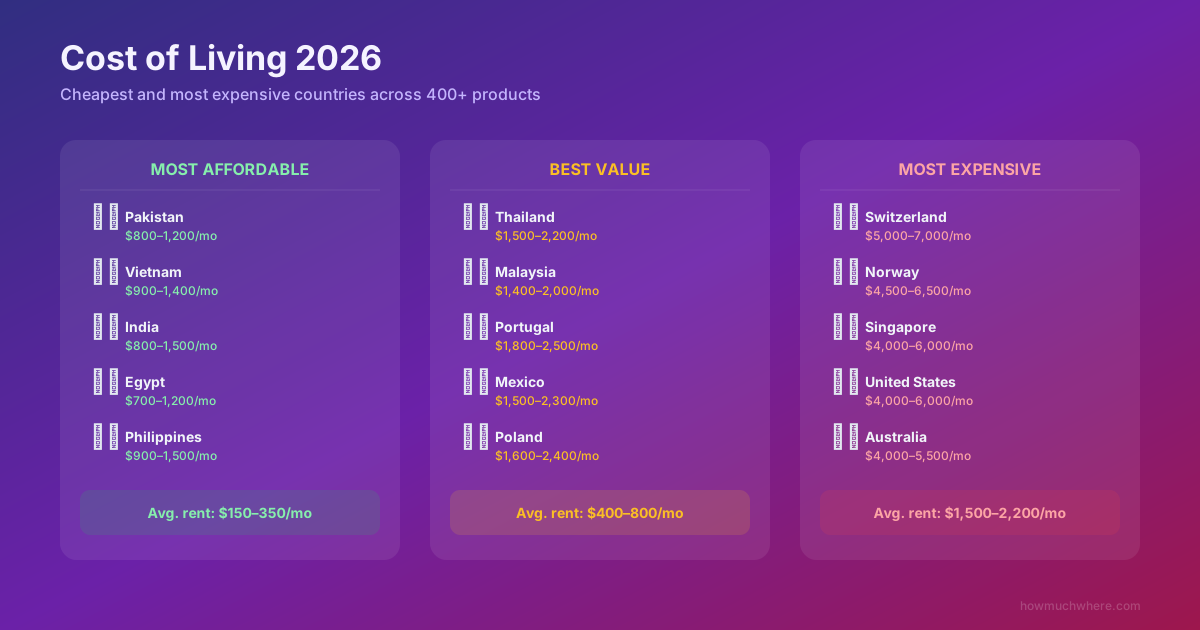
Most affordable countries: Pakistan, Vietnam, Egypt, India, Philippines, Indonesia. You can live comfortably on $800–1,500/month in these countries, including rent, food, transportation, and entertainment.
Best value mid-range: Thailand, Malaysia, Mexico, Portugal, Poland. These offer a blend of modern infrastructure, quality of life, and affordability. Budget $1,500–2,500/month for a comfortable urban lifestyle.
Most expensive: Switzerland, Norway, Singapore, Australia, United States. Expect $4,000–6,000/month minimum in major cities, and considerably more in places like Zurich or San Francisco.
Explore our country pages to drill into specific costs for any country, or compare two countries side by side to see exactly how prices differ.