Grocery Prices Around the World: A 2026 Comparison
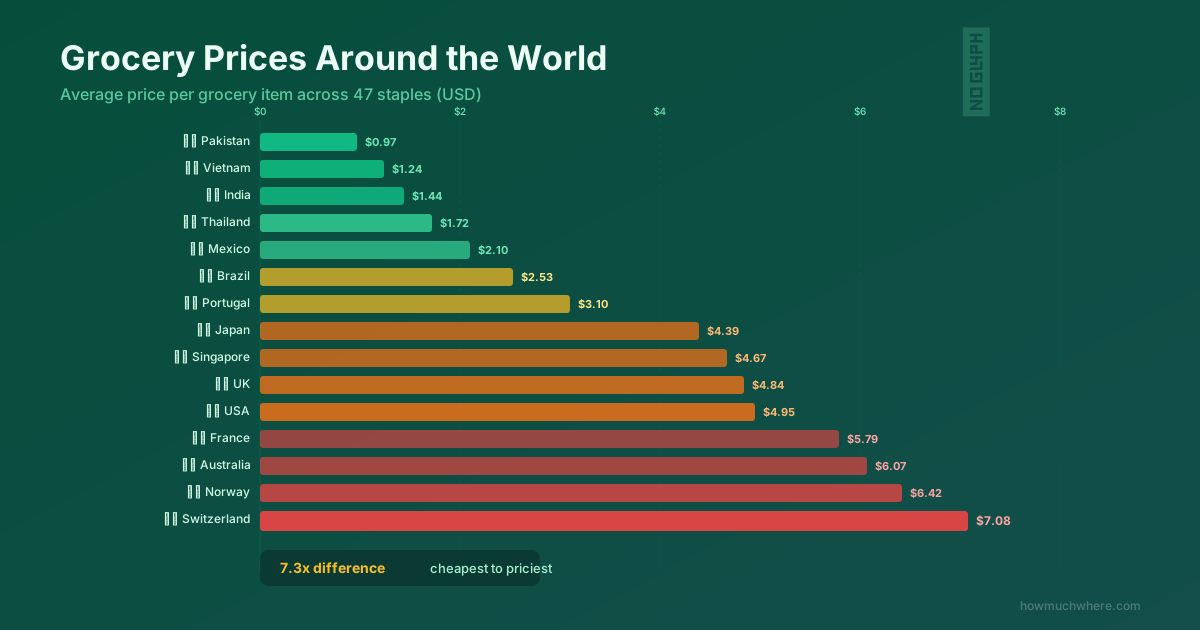
From $0.97 per item in Pakistan to $7.08 in Switzerland — we compared the average grocery price across 47 staples in 40 countries.
How much does a week's groceries cost where you live — and how does that compare to the rest of the world? We crunched the numbers on 47 everyday grocery items across 40 countries to find out.
The results are striking: the average grocery item costs $0.97 in Pakistan but $7.08 in Switzerland — a 7x difference for the same basket of rice, eggs, milk, bread, and fresh produce.
The 10 Cheapest Countries for Groceries
| Rank | Country | Avg. Price Per Item |
|---|---|---|
| 1 | 🇵🇰 Pakistan | $0.97 |
| 2 | 🇻🇳 Vietnam | $1.24 |
| 3 | 🇪🇬 Egypt | $1.24 |
| 4 | 🇵🇭 Philippines | $1.42 |
| 5 | 🇮🇳 India | $1.44 |
| 6 | 🇮🇩 Indonesia | $1.45 |
| 7 | 🇳🇬 Nigeria | $1.48 |
| 8 | 🇨🇴 Colombia | $1.55 |
| 9 | 🇹🇭 Thailand | $1.72 |
| 10 | 🇦🇷 Argentina | $1.77 |
South and Southeast Asia dominate the cheapest list. Low labor costs, local agricultural production, and proximity to food sources keep prices down. Pakistan and Vietnam offer the most affordable grocery baskets at roughly a dollar per item on average.
The 10 Most Expensive Countries for Groceries
| Rank | Country | Avg. Price Per Item |
|---|---|---|
| 1 | 🇨🇭 Switzerland | $7.08 |
| 2 | 🇳🇴 Norway | $6.42 |
| 3 | 🇦🇺 Australia | $6.07 |
| 4 | 🇫🇷 France | $5.79 |
| 5 | 🇸🇪 Sweden | $5.54 |
| 6 | 🇺🇸 United States | $4.95 |
| 7 | 🇮🇪 Ireland | $4.87 |
| 8 | 🇳🇿 New Zealand | $4.87 |
| 9 | 🇬🇧 United Kingdom | $4.84 |
| 10 | 🇨🇦 Canada | $4.75 |
Switzerland leads the pack at $7.08 per item — roughly 7x more expensive than Pakistan and 43% more expensive than the United States. Norway and Australia round out the top three, with strong currencies and island/remote geography pushing costs up.
Why Are Groceries So Expensive in Some Countries?
Agricultural self-sufficiency. Countries like Pakistan, India, and Vietnam produce most of their staple foods locally. Switzerland and Norway import a large share of theirs, adding transportation and tariff costs.
Labor costs. Farming, processing, packaging, and retail all require labor. Minimum wages in Switzerland are 15–20x those in Pakistan, and that flows directly into food prices.
Government subsidies. Many Asian countries subsidize staple foods like rice, wheat, and cooking oil. European and North American subsidies tend to target farmers rather than consumers, which keeps production going but doesn't always reduce retail prices.
Geography and climate. Tropical countries can grow food year-round. Nordic countries have short growing seasons and must import or greenhouse-grow many produce items.
Currency effects. When converted to USD, a strong Swiss franc makes everything look more expensive. But for a local earning in francs, the picture is different — which is why purchasing power parity matters more than raw prices.
The Middle Ground
Some countries offer a surprising balance of quality and affordability. Portugal ($3.10), Spain ($3.54), and Italy ($3.96) have grocery costs well below their northern European neighbors while maintaining high food quality standards. These Mediterranean countries benefit from year-round agriculture, especially for produce, olive oil, and wine.
South Korea ($3.98) and Japan ($4.39) are notably more expensive than their Asian neighbors, reflecting higher wages and quality standards — but still cheaper than most Western nations.
What Does This Mean for You?
If you're planning a move abroad, food is one of the first costs you'll feel daily. A family of four spending $800/month on groceries in the US could get by on roughly $230/month in India — or face a $1,140/month bill in Switzerland.
Browse our complete food and grocery price comparisons to see what individual items cost in any country.