The Big Mac Index: What Burger Prices Tell Us About the World Economy
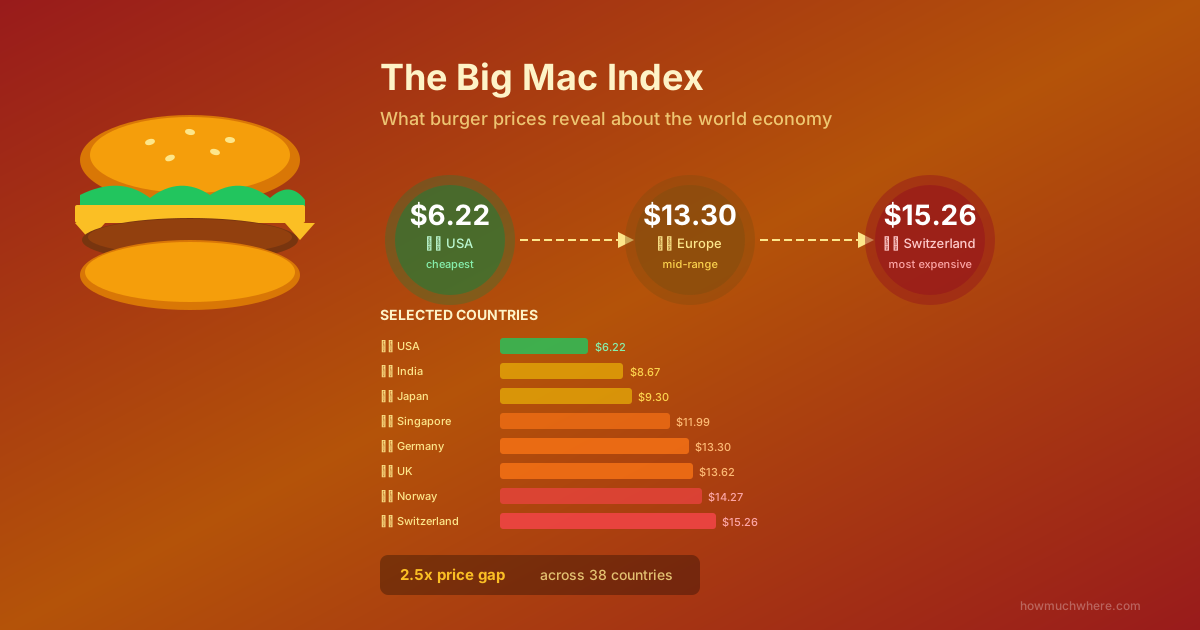
A Big Mac costs $6.22 in the US but $15.26 in Switzerland. We break down what McDonald's pricing reveals about purchasing power worldwide.
In 1986, The Economist invented the Big Mac Index as a lighthearted way to measure purchasing power parity between currencies. Nearly 40 years later, it remains one of the most intuitive economic indicators in existence — because everyone understands the price of a burger.
We tracked Big Mac prices across 38 countries. Here's what the data shows in 2026.
Cheapest Big Macs in the World
| Country | Price (USD) |
|---|---|
| 🇺🇸 United States | $6.22 |
| 🇮🇩 Indonesia | $8.60 |
| 🇹🇼 Taiwan | $8.64 |
| 🇮🇳 India | $8.67 |
| 🇵🇭 Philippines | $8.96 |
| 🇪🇬 Egypt | $9.09 |
| 🇻🇳 Vietnam | $9.11 |
| 🇯🇵 Japan | $9.30 |
The United States has the cheapest Big Mac by a wide margin at $6.22 — a reflection of America's massive agricultural subsidies, efficient supply chains, and intense fast-food competition. Southeast Asian countries cluster in the $8–9 range, where lower labor costs keep prices down despite the imported ingredients that McDonald's requires for consistency.
Most Expensive Big Macs
| Country | Price (USD) |
|---|---|
| 🇨🇭 Switzerland | $15.26 |
| 🇳🇴 Norway | $14.27 |
| 🇨🇴 Colombia | $14.22 |
| 🇬🇧 United Kingdom | $13.62 |
| 🇸🇪 Sweden | $13.38 |
Switzerland takes the crown at $15.26 — nearly 2.5x the US price. Swiss wages, strict food safety regulations, and one of the world's highest costs of living all contribute. Norway isn't far behind, driven by similar factors plus heavy agricultural import restrictions that raise ingredient costs.
What Does the Big Mac Index Actually Tell Us?
The Big Mac Index works because a Big Mac is essentially identical everywhere — same beef patty, same bun, same sauce. So price differences reflect real economic forces:
Labor costs. A McDonald's crew member in Zurich earns 5–8x what their counterpart in Jakarta makes. That cost goes directly into the burger price.
Ingredient sourcing. Countries that import most of their beef and wheat (like Japan and Singapore) pay more than agricultural powerhouses (like the US, Brazil, and Argentina).
Real estate. A McDonald's franchise in central London pays dramatically more rent than one in suburban Manila. Prime retail real estate is one of the largest operating costs for fast-food chains.
Currency strength. When we convert everything to USD, countries with strong currencies (Swiss franc, Norwegian krone) look more expensive simply because their money buys more dollars. This is actually the core insight of the index — it reveals which currencies are "overvalued" or "undervalued" relative to the dollar.
The Surprising Middle
Many European countries cluster around $13.30 — Germany, France, Spain, Italy, Netherlands, Austria, Ireland, and Portugal all charge virtually the same price. This makes sense: they share a currency (the euro), have similar VAT rates, and McDonald's operates with pan-European pricing strategies.
Beyond the Burger
The Big Mac Index is a starting point, not the whole story. A country where a Big Mac is cheap might still have expensive rent, healthcare, or electronics. That's why we track over 400 products across 40 countries — to give you the full picture.
Check our complete Big Mac price comparison to see exactly how much a Big Mac costs in your country versus anywhere else in the world.