
Electric Car Prices Around the World: Tesla Model 3 in 40 Countries
A Tesla Model 3 costs $33,150 in China but $116,366 in Singapore. We mapped EV prices across 40 countries and explain why the gaps are so extreme.
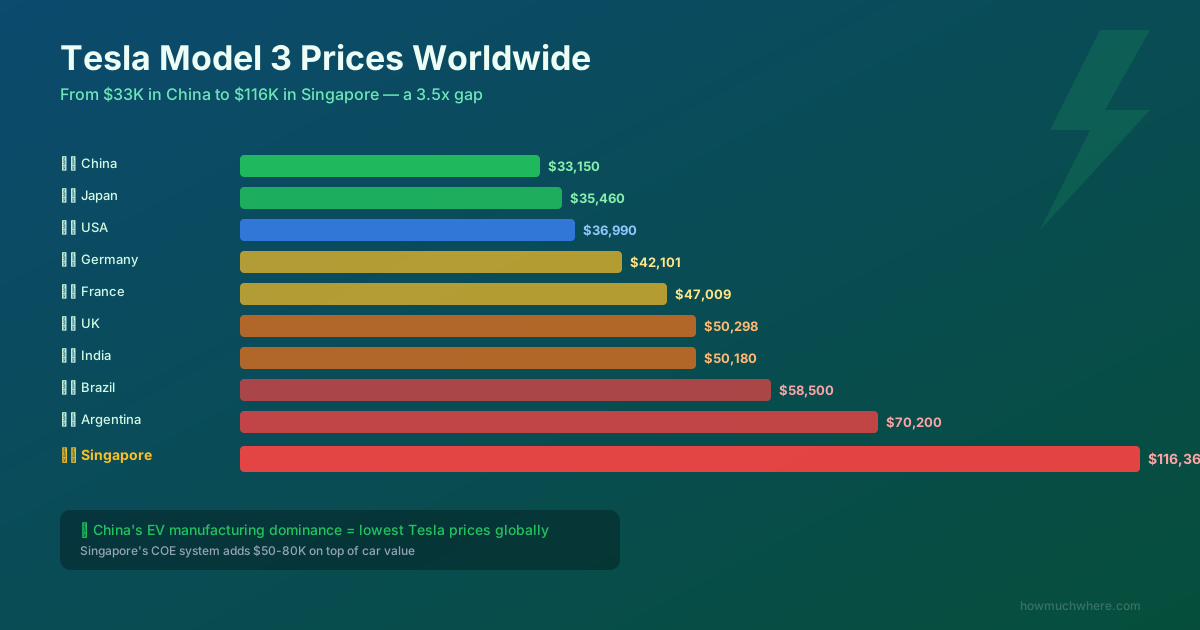
The electric vehicle revolution has gone global — but EV prices haven't equalized. A Tesla Model 3 ranges from $33,150 in China to an eye-watering $116,366 in Singapore, a 3.5x gap that reveals how government policy shapes the car market more than manufacturing costs ever could.
Tesla Model 3 Prices: Cheapest to Most Expensive
| Country | Price (USD) | vs. US Price |
|---|---|---|
| 🇨🇳 China | $33,150 | -10% |
| 🇸🇦 Saudi Arabia | $35,100 | -5% |
| 🇯🇵 Japan | $35,460 | -4% |
| 🇦🇺 Australia | $36,335 | -2% |
| 🇺🇸 United States | $36,990 | baseline |
| 🇩🇪 Germany | $42,101 | +14% |
| 🇫🇷 France | $47,009 | +27% |
| 🇬🇧 United Kingdom | $50,298 | +36% |
| 🇮🇳 India | $50,180 | +36% |
| 🇧🇷 Brazil | $58,500 | +58% |
| 🇦🇷 Argentina | $70,200 | +90% |
| 🇸🇬 Singapore | $116,366 | +215% |
China is the cheapest market because Tesla has a massive Gigafactory in Shanghai, producing vehicles with lower labor costs, no import duties, and generous EV subsidies. The US is the second cheapest — Tesla's home market with its own factories and federal tax credits.
Why China Leads the EV Price Race
China isn't just the cheapest place to buy a Tesla — it's the cheapest place to buy almost any electric vehicle. Several factors converge:
Domestic manufacturing. Tesla's Shanghai Gigafactory produces more vehicles than any other Tesla factory worldwide. Building locally eliminates 15–25% import tariffs that other markets face.
Battery supply chain. China controls approximately 75% of the world's lithium-ion battery manufacturing. Batteries represent 30–40% of an EV's cost, so proximity to battery suppliers dramatically reduces prices.
Government subsidies. China has spent over $100 billion subsidizing EV adoption through purchase incentives, tax breaks, and infrastructure investment. While direct consumer subsidies have decreased, the ecosystem benefits persist.
Competition. Chinese consumers can choose from BYD, NIO, XPeng, Li Auto, and dozens of other domestic brands. This competition forces Tesla to price aggressively — the Model 3 has seen multiple price cuts in China.
The Singapore Premium (Again)
Singapore's Tesla Model 3 price of $116,366 is the most extreme example of how policy shapes car prices. The same COE (Certificate of Entitlement) system that makes a Toyota Corolla cost $88,000 applies to EVs too — though Singapore offers modest EV-specific rebates.
Interestingly, Singapore's EV adoption is growing despite these prices, driven by wealthy buyers and the government's 2040 goal to phase out internal combustion engines.
Import Taxes: The Hidden Multiplier
| Market | Key EV Taxes |
|---|---|
| 🇧🇷 Brazil | 35% import duty + IPI + ICMS ≈ 60-80% total |
| 🇮🇳 India | 100% import duty on cars over $40K |
| 🇹🇷 Turkey | 50-80% combined duties |
| 🇦🇷 Argentina | 35% import + luxury tax |
| 🇪🇺 Europe | 10% import + 19-25% VAT |
| 🇺🇸 United States | 2.5% import (non-US made) |
| 🇨🇳 China | 0% (domestic Tesla) |
India stands out: a 100% import duty on vehicles priced above $40,000 effectively doubles the Tesla's price. This is a deliberate policy to encourage domestic EV manufacturing — and it's working, with Tata, Mahindra, and others ramping up local EV production.
EV vs. Gas: Where EVs Win on Price
In some markets, EVs are actually cheaper than equivalent gas cars when you factor in:
Norway — Zero VAT on EVs (25% on gas cars), free toll roads, free parking, and reduced ferry fares make EVs significantly cheaper to own despite higher sticker prices.
China — EV purchase tax exemption (worth 10% of vehicle price) plus license plate advantages in cities like Shanghai (where a gas car plate costs $13,000+ at auction, but EV plates are free).
United States — $7,500 federal tax credit (for qualifying models) plus state-level incentives that can total $10,000+.
The Global EV Affordability Challenge
The data reveals a fundamental tension: EVs are most affordable in wealthy countries (US, China, Norway, Germany) that can afford subsidies, while developing countries face the highest prices due to import taxes and lack of domestic production.
For a family in Brazil paying $58,500 for a base Tesla Model 3, or in India at $50,180, the EV revolution remains a luxury. Until more EVs are manufactured locally in these markets — or import policies change — the price gap will persist.
Explore our full Tesla Model 3 price comparison or browse all automobile prices across 40 countries.